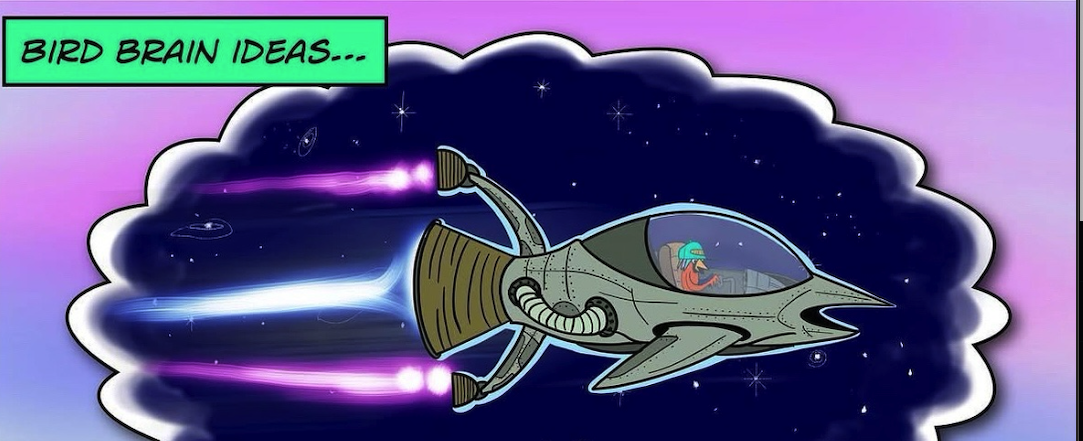
We Are a
Horizon
Species
A cartoonist’s signal on space exploration and the biology of going further — analyzed through the Gravificer lens.
The reveal is biological. Every cave painting is a dispatch from someone who walked farther than they needed to. Every ship that left a known coastline carried people who felt the pull of what’s next as strongly as hunger.
This is the signal. The current is older than any institution built around it. It predates writing. It predates fire by enough time that the people who felt it had no words for what they were feeling — just feet that kept moving.
The posture is identical across ten thousand years. The feeling is identical. The horizon just keeps moving.
— The Gravificer cartoonist signalA cartoonist understands something economists and engineers take longer to learn: compression reveals truth. When you reduce a thing to its essential lines, what remains is what it actually means.
Draw the same figure across ten thousand years — a person standing at an edge, looking outward, hand shading their eyes — and the only thing that changes is the edge itself. Cliff. Shore. Deck of a ship. Hatch of a rocket. The silhouette is a permanent data point about our species.
The whimsy lives in the continuity. That’s the cartoonist’s power: they can show you the same human impulse across geological time and make it funny and aching and true all at once. The cartoon panel that rhymes a cave mouth with an airlock isn’t just a visual joke — it’s a proof.

The Repeating Silhouette
The figure at the edge is the primary signal. Every visual iteration — from cliff-edge to airlock — is the same cartoon panel, redrawn by time. The cartoonist doesn’t create this image. They recognize it.
Deep Biological Pull
The force operates below ambition — at hunger-level compulsion. It runs through every institution built around it, but it doesn’t originate there. The current is older than any structure designed to carry it.
Base Camp, Not Destination
Every lunar habitat is a base camp. The destination is always the next visible thing from where you currently stand. The Moon doesn’t end the impulse — it arms it with a new vantage point.
The Horizon Keeps Moving
The pattern is the point. Horizon-seeking is not a goal state — it’s the operating mode of the species. From this pattern, all exploration architecture derives. The habitat is a tool for producing the next horizon.
The useful signal underneath: building on the Moon is not humanity leaving Earth. It’s humanity doing what humanity does — extending the boundary of where a person can stand and call it here. Every habitat we build up there is a base camp, not a destination. The destination is always the next thing visible from where you currently are.
One panel. A child standing on the lunar surface in a suit two sizes too big, hand shading their visor, looking out at a star that — from here — you can finally see is a sun with planets around it.
// The horizon moved again. They’re already wondering what’s over there.
// No caption needed. The posture says everything.
A cartoonist sees this clearly because they work in reduction. Strip the noise — what remains is a child at an edge, looking outward, already calculating the next edge from the one they’re standing on.
This is not metaphor. This is the mechanism. The habitat is infrastructure for producing horizon. The rocket is a tool for moving the vantage point. The exploration impulse is a biological constant — older than any institution built to channel it.
The Gravificer question is never “should we go?” It’s “what does this reveal about the thing that sends us?” The answer, drawn in one panel by a cartoonist who understands reduction: we are a species that has always needed a horizon. Build the base camp. Wait for the child to point at what they can see from there that we couldn’t see from here.
The destination is always the next visible thing.
Leave a Reply