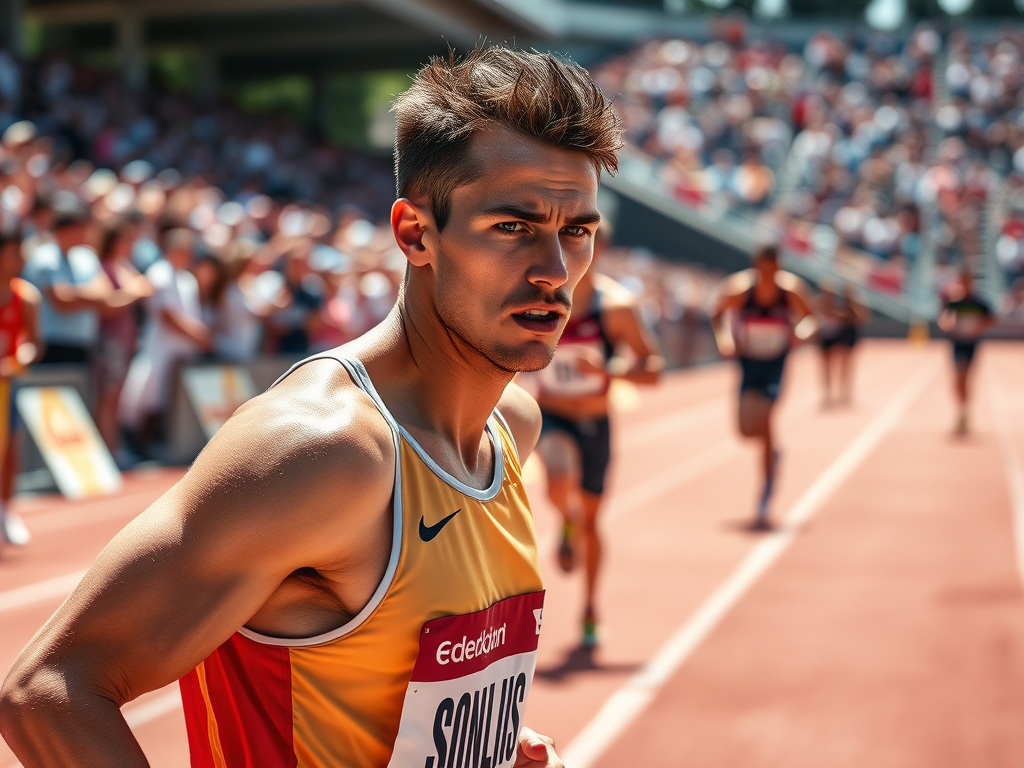
THE MIDDLEDISTANCERUNNER
Physiological architecture, energy system demands, and tactical intelligence across five racing distances
The middle distance runner occupies a singular physiological territory — too brief for pure endurance, too long for raw anaerobic power. This analysis maps the competing forces, metabolic demands, and training architecture required to compete across all five distances, revealing the precise intersection where speed and stamina must coexist in one body.
Two Athletes.
One Body.
Every elite middle distance runner resolves a fundamental contradiction daily. Speed demands explosive fast-twitch fiber recruitment, high anaerobic output, and the willingness to flood the system with lactate. Endurance demands the opposite — mitochondrial density, fat oxidation efficiency, and the capacity to sustain effort at 85–92% VO₂ max without structural collapse.
The 800m asks the runner to be 60% sprinter. The 3200m asks the same athlete to be 90% distance runner. Mastery across the range requires developing both systems simultaneously — and the tactical intelligence to deploy each at the precise moment a race demands it.
Fast-twitch fiber dominance. Anaerobic glycolysis. Lactate production and tolerance. Neuromuscular power output. Sprint mechanics and ground force application.
Aerobic capacity ceiling. Mitochondrial density. Lactate clearance efficiency. Running economy. Sustained output at race-specific VO₂ demand.
Energy System
Signatures
Each race distance imposes a distinct metabolic signature. The relative contribution of anaerobic versus aerobic pathways shifts dramatically across the five distances — which is why programming for the full range is among the most complex challenges in track athletics.
* Approximate physiological contribution ratios. The 800m remains the most metabolically violent race in competitive athletics — a sustained anaerobic demand that no sprint or distance event replicates.
Five Races.
Five Identities.
Each distance has a distinct tactical and physiological character. A runner who understands only fitness but not the identity of each race will consistently be outmaneuvered by a less-fit athlete who does.
Six Forces That
Shape Every Race
Performance in middle distance running is determined by forces largely invisible to spectators. Understanding each force — and which training stimulus develops it — is foundational knowledge for every serious competitor and coach.
Maximum oxygen consumption at peak effort. The genetic ceiling every athlete trains up to. Elite middle distance runners operate between 65–80 ml/kg/min. You cannot race beyond your ceiling — only closer to it, for longer.
The pace at which lactate accumulates faster than it can be cleared. Exceed it and the body acidifies — muscles seize, form collapses, pace unravels. Raising the threshold is the central mission of every training block.
Oxygen cost per unit of pace. Two runners with identical VO₂ max — one runs faster. That’s economy. Stride mechanics, arm carry, ground contact time, elastic tendon recoil — invisible fractions compounding across every lap.
The nervous system’s speed and completeness of fast-twitch fiber activation. Without this, there is no kick. Built through speed work, strides, and hill sprints. This is the gear that separates athletes in the final 150m.
Race reading. Knowing where to be at 400m. When to cover a surge. When a move is real versus bait. A runner who races only fitness loses to one who also races the field. Position has a metabolic cost. Being boxed costs races.
Precise interpretation of physiological distress — distinguishing productive discomfort from injury signal. Holding the edge of sustainable output for exactly the right duration. Miscalibration leads to early fade or unnecessary restraint.
Five Phases.
One Runner.
The annual training cycle for a multi-event middle distance athlete is structured in progressive phases — each one building the physiological substrate the next requires. Skipping phases produces athletes who perform well early and collapse under race season load.
Aerobic volume at easy effort — 60–70% of max heart rate. Accumulated mileage builds mitochondrial density, capillary networks, and fat oxidation efficiency. A middle distance runner without an aerobic base is a sports car with a small fuel tank: fast briefly, then finished.
Tempo runs and cruise intervals at 80–90% max heart rate. The body learns to clear lactate faster. Comfortably hard becomes the training texture — never painful, never easy. This phase builds the runner’s performance floor and is the most transferable work across all five distances.
VO₂ max work: 400m, 600m, and 800m repeats at and above race pace with short recovery. The body adapts to the exact chemical environment of competition. Heart rate reaches 95–100% ceiling. This phase simulates the race. Pain is the curriculum.
Strides and short speed — 150–200m at 95% effort. Volume drops, quality rises. Neural activation. The body sheds accumulated fatigue while the nervous system wakes to maximal speed. Time it correctly and the athlete arrives at competition as a weapon.
Races become the primary teacher. Competition provides physiological and psychological stimuli no workout can replicate: adrenaline, unpredictable pacing, tactical demands, and real pressure. Race identity is forged here. The runner discovers who they are when it matters.
Leave a Reply